
Types of Pearls and Pearl History: Akoya, South Sea, Tahitian and Freshwater
Pearls: a timeless gem made by living creatures
Pearls are one of the few gems made by living creatures, and that origin sets them apart from most of the stones in a jewellery box. A diamond or a ruby is cut and polished from mineral rock. A pearl is finished the moment it leaves the shell, its glow built layer by microscopic layer inside an oyster or mussel over months or years.
In many cultures, pearls have long been linked with purity, dignity and wealth. They have been worn at weddings and in royal courts, and families often pass strands down as heirlooms. Today the choice is wider than ever: classic round Akoya strands, golden South Sea pearls, dark Tahitian shades and playful freshwater shapes.
This guide covers pearl history, how pearls are made, the main types of pearls, how a strand is knotted by hand, how to choose a necklace length, how to care for pearls and how to judge quality. For other stones and metals, see our jewellery care guide.

Pearl history: the seven ages of the pearl

- 1The dawn of pearlsCoastal communities probably found pearls long before written records, while gathering shellfish for food. Where and when pearls were first worn is not firmly established, so historians speak in broad terms rather than exact dates.
- 2Treasure of kingsNatural pearls were so rare that they became treasure. Fisheries in the Persian Gulf, the Red Sea and the Gulf of Mannar supplied royal courts. The story that Cleopatra dissolved a pearl in vinegar is a legend, not a documented event.
- 3Courts and empiresPearls travelled along Indian Ocean sea routes and overland trade routes, and were set into crowns, robes and necklaces at royal courts. A strand of pearls became a visible sign of rank and wealth.
- 4The age of diversFor centuries, natural pearls were gathered by free-divers who held their breath on every descent. Each shell had to be opened to find out whether it held a pearl, and most did not. Natural pearl fishing declined sharply in the early twentieth century.
- 5The cultured revolutionIn early twentieth-century Japan, Kokichi Mikimoto and other pioneers perfected ways to start a pearl inside a farmed mollusc. Cultured pearls are real pearls, and they made fine strands far more widely available.
- 6Pearls in fashionThrough the twentieth century, pearl strands moved from royal courts into everyday wardrobes. They became a classic of formal dress and a common gift for weddings and milestones.
- 7Pearls todayToday buyers can choose Akoya, South Sea, Tahitian and freshwater pearls, from classic strands to modern designs for women and men, in India and around the world.
How pearls are made: natural and cultured pearls
A pearl forms when a mollusc coats a tiny irritant or nucleus with thin layers of nacre. In a natural pearl the start is chance, which is why natural pearls are so rare. In a cultured pearl, a pearl farmer begins the process on purpose: a small bead or a piece of mantle tissue is placed inside a living oyster or mussel, and the animal builds nacre around it.
Cultured pearls are genuine pearls. They form by the same biological process as natural pearls, with a person starting the journey. Early in the twentieth century, pioneers in Japan, including Kokichi Mikimoto, made the method practical at scale, which is why fine strands are widely available today.
| Factor | Natural pearl | Cultured pearl |
|---|---|---|
| How it starts | A chance irritant or parasite enters the mollusc | A bead or tissue graft is placed by a pearl farmer |
| Rarity today | Extremely rare (museums, auctions, old heirlooms) | Widely available in fine jewellery |
| Real pearl? | Yes, genuine nacre | Yes, genuine nacre |
| Nacre | Concentric layers of nacre built around a natural core | Concentric layers of nacre built around a bead or tissue graft |

Types of pearls: Akoya, South Sea, Tahitian and freshwater
The four main types of cultured pearls differ mostly by the mollusc that grows them. Its size, habitat and diet shape the pearl's size, body colour and sheen.
| Variety | Mollusc | Primary origin | Typical size | Natural colour range | Key character |
|---|---|---|---|---|---|
| Akoya | Pinctada fucata martensii | Japan, China | 6–8 mm | White or cream with rose or silver overtones | Strong mirror-like lustre, very round |
| South Sea | Pinctada maxima (gold or silver lip) | Australia, Indonesia, Philippines | 10–16 mm | Silvery white to deep champagne gold | Largest cultured pearls, thick satiny nacre |
| Tahitian | Pinctada margaritifera (black lip) | French Polynesia | 9–14 mm | Peacock green, aubergine, charcoal, pistachio | Naturally dark body colour with iridescent overtones |
| Freshwater | Hyriopsis schlegelii / cumingii (mussels) | China | 5–12 mm | White, peach, lavender, pastel pink | Many shapes, solid nacre, good value |
1. Akoya pearls: the classic strand
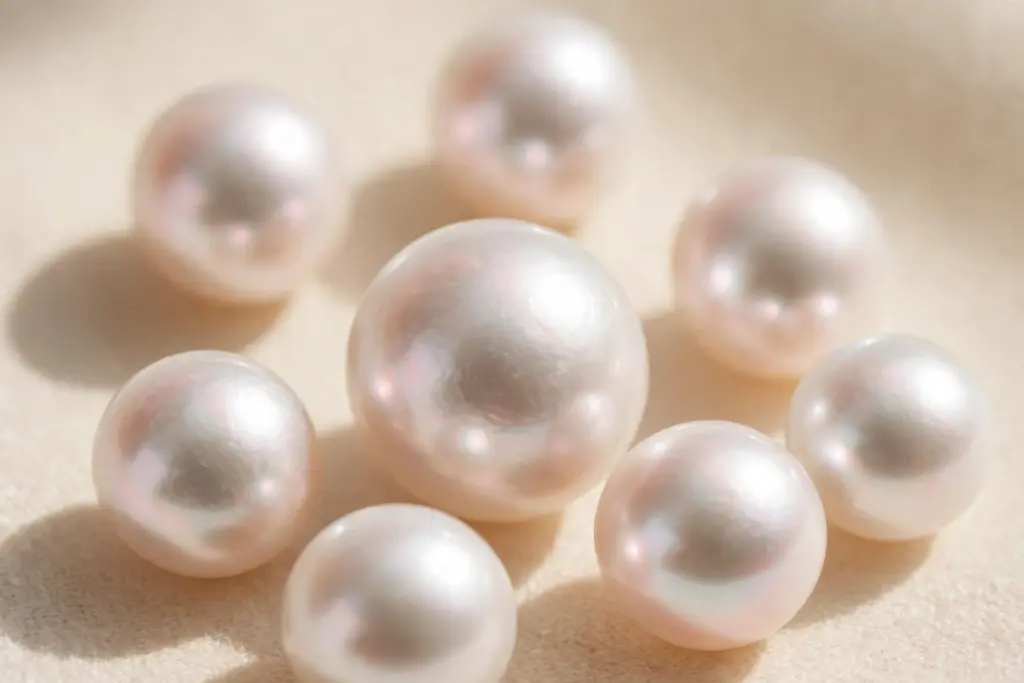
Akoya pearls are grown in the cooler coastal waters of Japan and China. Their fine nacre gives a crisp, mirror-like reflection, and they are the pearls most people picture in a classic necklace. They suit princess and matinee strands, where evenness and brightness matter most. Browse our pearl strand necklaces to see classic strands.
2. South Sea pearls: large and satiny
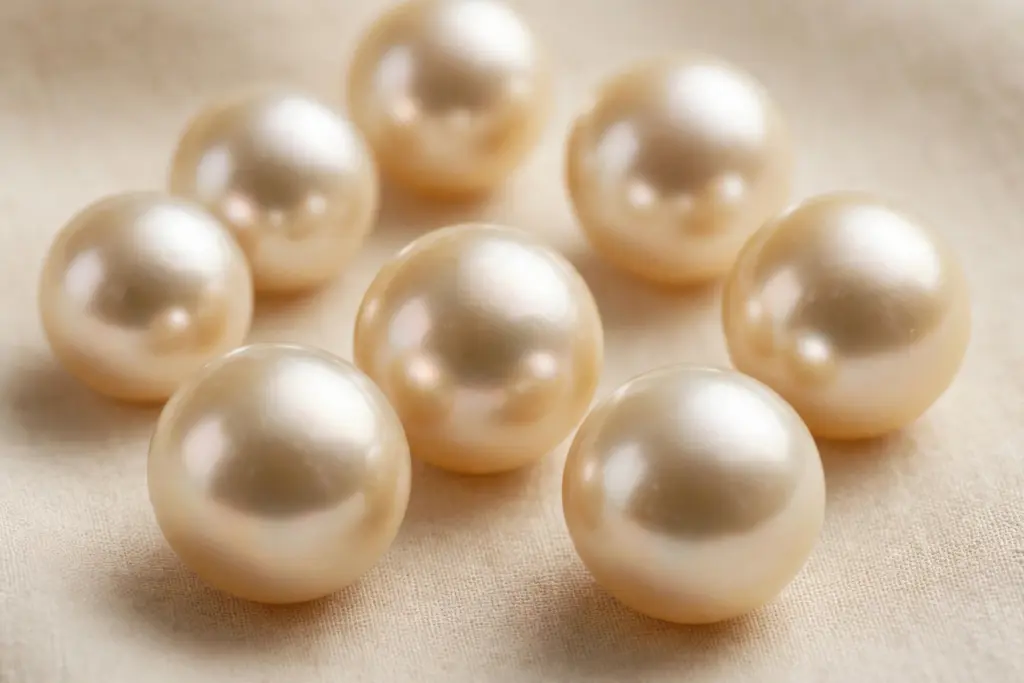
South Sea pearls are grown in large silver-lipped and gold-lipped oysters in Australia, Indonesia and the Philippines. They grow slowly and can reach a generous size with thick nacre, which gives a warm, satiny glow. Their scale suits statement pieces; see our women's necklaces.
3. Tahitian pearls: dark and iridescent
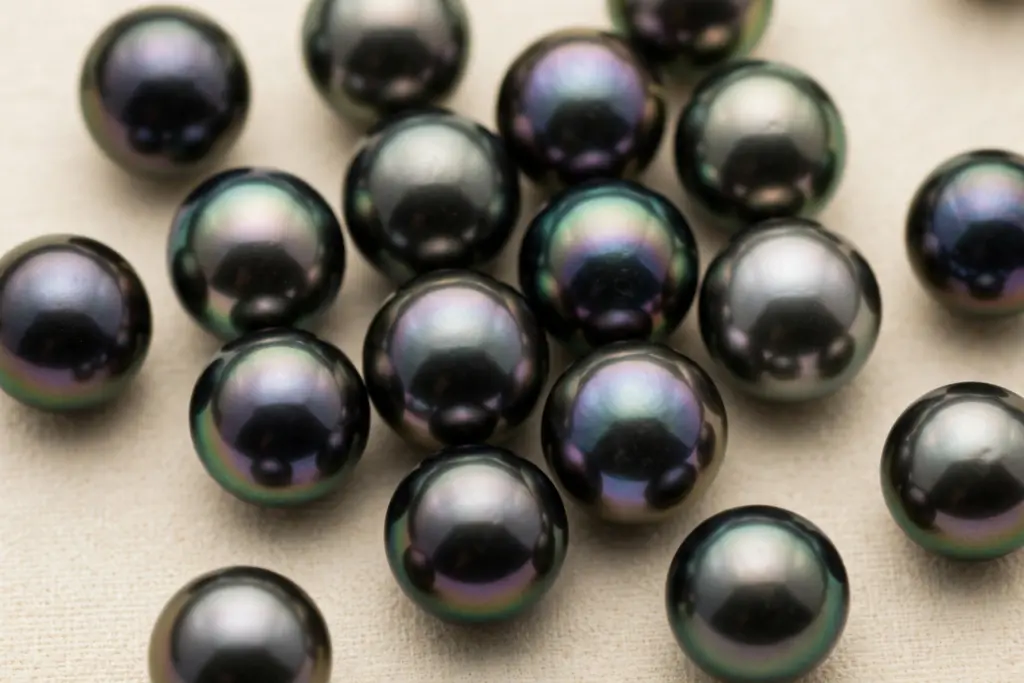
Tahitian pearls are grown in black-lipped oysters in the atolls of French Polynesia. They are known for naturally dark body colours, with overtones of peacock green, blue and aubergine. Their depth suits bold, contemporary designs, including men's beaded necklaces.
4. Freshwater pearls: colour and variety
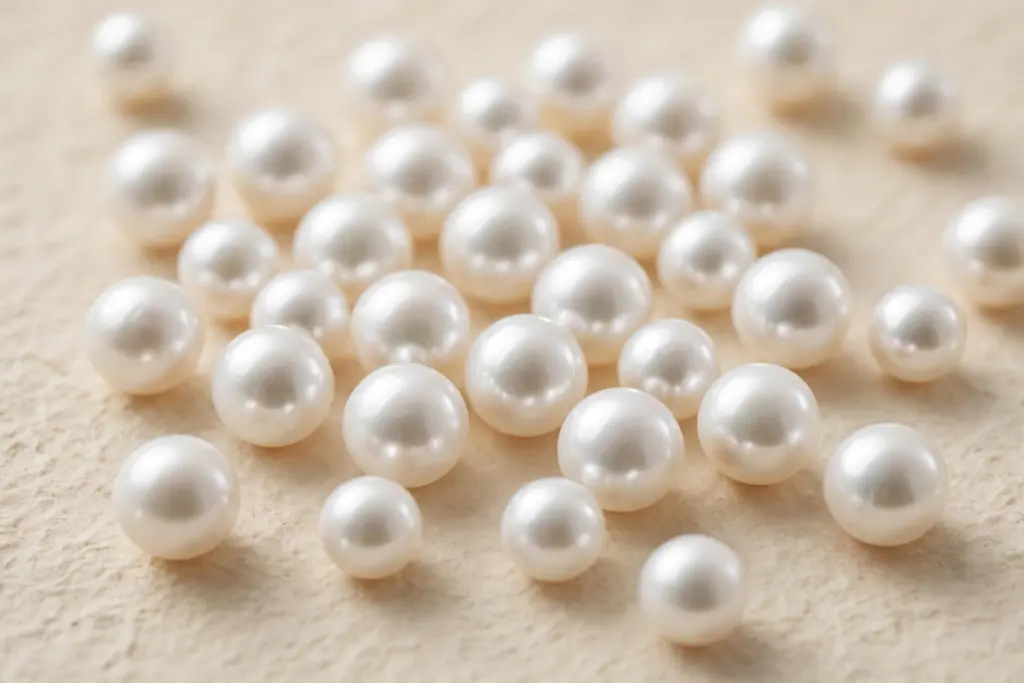
Freshwater pearls grow in mussels in lakes and rivers, not in saltwater oysters, and are formed almost entirely of nacre. They come in many shapes and soft natural colours such as white, peach and lavender, and good ones can be very round. They are a practical choice for everyday and festive wear, including jhumka earrings.
Pearl craftsmanship: from loose pearls to a hand-knotted strand
A harvested pearl is not ready to wear. Turning loose pearls into a necklace takes four careful stages, and each one affects how the strand drapes, shines and lasts.
A raw pearl and a finished pearl
On the left, a raw pearl as harvested. On the right, a finished pearl that has been drilled and polished, ready for knotting.


Pearl necklace length guide for women and men
Necklace length changes the character of pearls, from close and bridal to long and dramatic. Pick the length that suits your neckline and outfit. The table below shows how each one sits.
| Style | Standard length | Where it sits | Wardrobe pairing |
|---|---|---|---|
Choker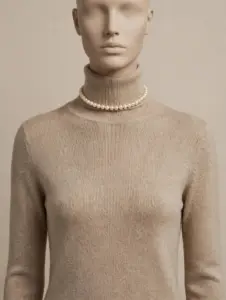 | 14–16 in (35–40 cm) | Snug around the base of the neck. Best for open collars, off-the-shoulder gowns and dramatic formal wear. | Boat necks, scoop necklines, strapless gowns |
Princess (most popular)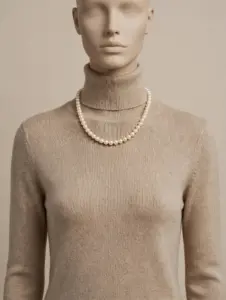 | 17–19 in (43–48 cm) | Sits gently below the collarbone. The most versatile length; pairs with crew necks, V-necks, blazers and bridal outfits. | Blazers, open blouses, bridal wear |
Matinee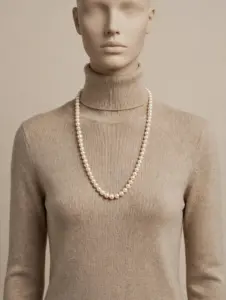 | 20–24 in (50–60 cm) | Falls at the centre of the décolletage. Suits tailoring, high-neck knitwear and evening silk. | Office tailoring, knitwear, high necks |
Opera / Rope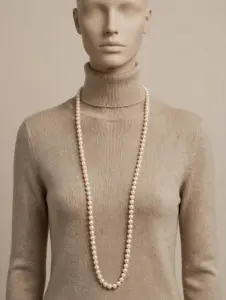 | 28–36+ in (70–90+ cm) | Falls at or below the bust. Wear it as one long strand, knotted, or doubled into a two-strand choker. | Evening dresses; can be doubled into two strands |
Men's single strand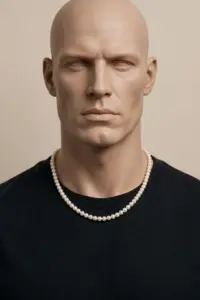 | 16–18 in (40–45 cm) | Sits between the collarbone and the base of the neck. | Open linen shirts, dark jackets, casual wear |
For women: understated luxury
A princess-length strand of about 18 inches is the easiest place to start. It works with a tailored blazer, a silk saree blouse or a simple kurta. For weddings and festive occasions, many people layer a pearl strand with gold pieces, or pair it with pearl jhumkas for an Indian outfit. See the full range of pearl strand necklaces.

For men: quiet confidence
Pearls are a growing choice in men's jewellery. A short strand of about 16 to 18 inches sits at the collarbone and looks good against an open collar or a dark jacket. Dark Tahitian shades and slightly baroque shapes give a relaxed, modern look. Explore men's beaded necklaces or all men's necklaces.

How to care for pearls: last on, first off
Unlike mineral gems such as diamonds or sapphires, pearls are organic. Nacre is made mostly of calcium carbonate platelets held together by a protein called conchiolin. Pearls rate only about 2.5 to 4.5 on the Mohs scale, so they scratch easily, and acids, alcohol, perfume, hairspray and perspiration can dull their lustre.
After each wear, wipe pearls with a soft, lint-free cloth, slightly damp with clean water if needed. Avoid ultrasonic cleaners, steam, alcohol and harsh detergents.
Keep strands flat in a soft pouch or lined box. Do not hang a pearl necklace, because its weight stretches the silk over time.
Silk stretches and collects dirt with wear. Check it regularly, and have a strand that is worn often restrung on fresh silk when it looks loose or grubby, often every one to two years.
For every other stone and metal, see our jewellery care guide.
How to tell real pearls from fake
These checks give a useful first impression. None of them is a certificate.
- The tooth test. Rub a pearl very lightly against the edge of a tooth. Real nacre feels slightly gritty, while many imitations feel glassy-smooth.
- Temperature and weight. Real pearls usually feel cool to the touch and have a noticeable weight. Plastic and glass beads often warm up quickly.
- Look at the drill hole. Coating that chips or peels around the hole suggests a painted bead. Real nacre has layers and does not flake like paint.
- Look for small differences. Real pearls vary slightly in shape, surface and tone. A strand where every bead is perfectly identical deserves a closer look.
- Use magnification. A 10x loupe can show the fine texture of nacre. Imitations often show a uniform, bubbly or dotted coating.
Cultured pearls are real pearls, so these checks cannot separate natural from cultured pearls. A gemmological laboratory or a trusted jeweller gives the definitive answer. Ask for a written statement of what you are buying.
Pearl quality factors: how to judge pearls
Gemmological laboratories and jewellers commonly describe pearls using the factors below. There is no single scoring system used everywhere, so ask any seller to explain how they describe quality, and compare pearls side by side.
| Factor | What it means | What to look for |
|---|---|---|
| Size | Diameter in millimetres | Larger pearls are rarer in each type and usually cost more. Choose a size that suits your neck and your wardrobe. |
| Shape | How round or regular the pearl is | Round pearls are the rarest in most types. Drops, ovals and baroque shapes have their own character and are often better value. |
| Colour (body colour and overtone) | The main shade, and the soft tint that floats over it | Rose on white, or peacock on dark. Hold pearls against your skin in daylight and choose what flatters you. |
| Lustre | How sharp and bright the reflection is | A crisp, clear reflection usually points to healthy, dense nacre. Dull, chalky pearls look flat. |
| Surface quality | Marks on the surface | Few blemishes, pinpricks or wrinkles. Small marks are common on real pearls. |
| Nacre quality | The thickness and condition of the nacre layers | Thick, even nacre lasts longer. Thin nacre can wear through or peel. Ask the seller about it. |
“A diamond derives brilliance from the cutter's wheel. A pearl owes its soul entirely to the sea, reflecting light not with sharp facets, but with quiet, deep lustre.”
Navidha Pearls & JewelryPearl questions, answered
Are cultured pearls real?
Yes. A cultured pearl forms inside a living mollusc and is built from the same nacre as a natural pearl. The difference is how it starts: a person places a small nucleus or tissue graft inside the shell, and the mollusc does the rest. Natural pearls form without that help and are far rarer, so most fine pearl jewellery today uses cultured pearls.
Which pearl suits my skin tone?
There is no strict rule, but overtone helps. Pearls with rose overtones are often chosen to flatter cooler skin tones, while cream and golden pearls often sit well against warmer tones. Dark Tahitian shades suit most tones and add contrast. Try pearls against your face in daylight, or book a video consultation and compare a few options with an advisor.
What pearl necklace length should I choose?
Princess length, about 17 to 19 inches, is the most versatile and sits just below the collarbone. Choose a choker for open necklines, a matinee for high necks and tailoring, and an opera length for a dramatic or doubled look. The length selector above shows how each length sits, and an advisor can help you decide.
How often should I restring pearls?
It depends on how often you wear them. With regular wear, many jewellers suggest restringing on fresh silk every one to two years, and less often for pieces worn only occasionally. Check the silk for stretching, dirt or gaps between the knots, and restring sooner if you see them. A jeweller can inspect a strand for you.
How can I tell real pearls from fake?
Real pearls feel slightly gritty when rubbed lightly against the edge of a tooth, feel cool to the touch and show small natural differences in shape and surface. Imitations are often glassy-smooth and perfectly uniform, and may chip or peel near the drill hole. These are only guides. A gemmological laboratory or trusted jeweller gives the definitive answer.
Find your pearls
Hand-strung strands, drops and studs, finished by our artisans. See them with an advisor on a video call, or visit the studio.
Shop pearl necklacesBook a video consultation